Posts

Showing posts with the label teaching practices

Reflecting on the 18-19 School Year: Grading Practices
Image
If you've read my blog before, you know I mostly write about my experiences trying to reform grading practices in my traditional world history classroom in order to help increase equity and student motivation. Over the past few years, I have tried different formats of Standards-Based or Standards-Referenced learning and grading all within the limitations of a traditional online grade book and strict reporting windows. When I first started the grade reform journey I did not know I would end up going standards-based and what I eventually settled on was something called Reflective Standards-Based Grading . In this type of grading, you work towards learning objectives and students self-assess on those learning objectives with a clear rubric for each standard. They must provide evidence of mastery when they self assess which is typically classwork, quizzes, tests, essays, or projects. They turn this in for summative assessment and are given feedback if they do not achieve mastery ...
How Routines Can Help You Embrace EdTech in Your Classroom

Image
Last week, I wrote a little bit about how I want to establish more clear routines and procedures this semester and it got me thinking about where and when routines benefit my students and me the most. As I wrote before, my big takeaway from the first semester of this year was the need to begin and end each class, in the same way, each day so students know where to find the information they need to be successful. But another area where I know from experience routines are helpful is when implementing technology. Now, I am not talking about how you check out devices (though that does help) I am talking about the actual lessons you do. When you are new to using technology in the classroom it can seem overwhelming at first, there are just so many apps and tools and cool lesson designs and incredible ways to connect your classroom with the world and so on and so on. But if you are new to using tech in your classroom there are three realities you need to face: 1) you can't do it a...

6 Articles to Get You Thinking About Grade Reform

Image
I've spent the past few years reading everything I could about grading practices. I have been so lucky to be supported by my admin team as I have tried new things in my classroom and now that I have a few years under my belt I have even had the chance to start helping others find the best practices for them.  When I help teachers who are considering new practices, I always start with a list of favorite books but the reality is most of us don't have the time or energy to dive into a book unless we know it is really going to help us. With grading practices that means knowing enough about grade reform practices to know if it is the right time for you to make a change and little of what those changes might look like.  Because of this, I decided to put together a list of some of my favorite articles that might help you determine if it's time to dig deeper and learn more. Articles on why teachers have changed their practices and how to determine if you are read...

Where to Start with Standards-Based Grading: Step 4

Image
It's time to talk about formative assessment. I might write some things that you totally disagree with and that is okay, I am not 100% sold that grading practices are one size fits all. In fact, this next year my AP World History course and my course for English Learners are following two slightly different grading formats based on the pacing, content, skills, and needs of the students. Sometimes it makes sense for me to assess the two classes in slightly different ways. That being said, I am going to make one of my most controversial statements yet. So far, everything has been pretty straightforward, but now it's time to really question the way we've always done it.  What no longer makes any sense to me is putting formative assessments in the grade book.   When I give quizzes students find out their score immediately, they find out what they got right and what they got wrong and what the correct answer is but that score never goes in the grade book. I usually as...

Surviving My First Year of AP World

This. Course. Is. Insane. That was what I thought a year ago sitting in APSI with Aaron Marsh as he explained, very eloquently, how he managed to teach a critical analysis of 10,000 years of human history, 3 massive writing rubrics, and still managed to give his kids minimal homework. But then again, every AP class is borderline insane. In AP classes and on AP Exams we often ask very young people to do the extraordinary and this year I was excited/scared/terrified/thrilled/pumped to take on that challenge of helping students meet those goals. AP World History is often the first AP course students at my school take. To be honest, I am not the biggest fan of the AP model but I LOVE the content and skills that an AP course has to offer. When given the chance to teach this course, I jumped at it but, as I usually do I went in with some crazy ideas. I approached the class with three clear goals: Goal #1 : I wanted to give minimal homework and outside reading to ensure my athletes and...

Grading Practices: How I Plan Using Standards Based Grading

Image
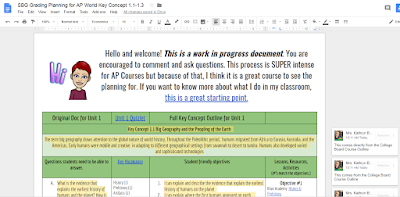
I've talked a lot about the challenges of reforming your grading practices but I want to give you a chance to see what those challenges really look like. I am currently rewriting and revising all of my AP World History Course with more specific objectives. A mistake I made last year with that course was making the objectives too broad and not having students reflect often enough, s o now I am taking a totally different approach and you are invited to visit my in progress planning document and leave questions and comments on the document as I work on it! One common question I get is about skills based objectives. The Common Core standards put literacy in every classroom (which I love) but the standards also ask teachers to assess skills and the skills are typically not one and done, they build throughout units or throughout the year. They are a part of multiple lessons and it is hard to determine the best way to approach reoccurring skills when Standards Based Grading. This i...

Civics and the new California HSS Framework

Last time, I shared how I plan using the new C3 Framework and the California HSS Framework that was adopted in 2016. Today I want to talk about one of the four main components of the framework and how I work to incorporate it in my classroom: Civics and Citizenship. The Framework states: From the earliest grade levels, students learn the kind of behavior that is necessary for the functioning of a democratic society in which everyone’s fundamental human rights are respected. They learn sportsmanship, fair play, sharing, respect, integrity, and taking turns. They should be given opportunities to lead and to follow. They should learn how to select leaders and how to resolve disputes rationally. They should learn about the value of due process in dealing with infractions, and they should learn to respect the rights of the minority even if this minority is only a single, dissenting voice and to recognize the dignity of every person. These democratic values should be taught in the class...

Planning with the New California Framework

I love our history department and I love how committed my colleagues are to creating engaging lessons for our students. Recently, I've been working with my department on how best to approach the three massive documents California Social Science teachers are supposed to incorporate in their classrooms.  This slide deck reviews how I approach the new California Framework and the existing California State Standards.  What I have found most useful are these planning sheets ( Grade 8 , Grade 10 ) I use when working through what I've used in the past and comparing it to what the Framework asks teachers to now focus on.  I plan to create another deck with resources on how to mix the framework, content standards, and the CCSS Literacy Standards but for now feel free to check out this deck ! It works kind of like a Hyperdoc so feel free to click the links and engage in the activities.

Why I Use Technology In My Classroom

There are a lot of arguments to be made about pedagogy and edtech. We could have a long discussion about the SAMR model. We could talk about the many reasons why technology could never replace teachers. We could talk about how much time students already spend in front of screens. But today, I just want to talk about why it is so important to find ways to incorporate technology in our classrooms because if we really want students to be college and career ready we have to embrace the fact that their experience is one we cannot truly predict. My own experience with technology:  Yes, it is true that I barely remember life pre-personal computer in my home. In middle school,  I was able to recreate the sound of our dial-up internet perfectly. By high school, I thought I was the queen of the AIM Away Message. In college, I had a LiveJournal and my college actively campaigned to be added to this new social networking thing called "Facebook." But in school, I only took two cla...

Some thoughts on tech and skills in the classroom

Image
In my last blog post I made the following statement regarding tech in the classroom " Just because something is better for me as a teacher doesn't mean it is best for my students and this just might be an example of that." After writing those words and hitting "publish" I kept thinking about them and felt the need to address the real issue that led me to write those words.  In my last post, I talked about challenges I was facing with reflective grading. A major challenge this school year has been consistent and equitable access to technology for my students. That week, I had to pull the plug on using technology to submit their reflections because I could not promise my students would have consistent and equal access to the technology required to do that. In that moment, technology was making my life easier but it was making things inequitable for my students. It was clear that I needed to make a change.  But I have a huge problem with this. There are tw...

Going "Grade Less" Bumps in the Road Part 2

Image
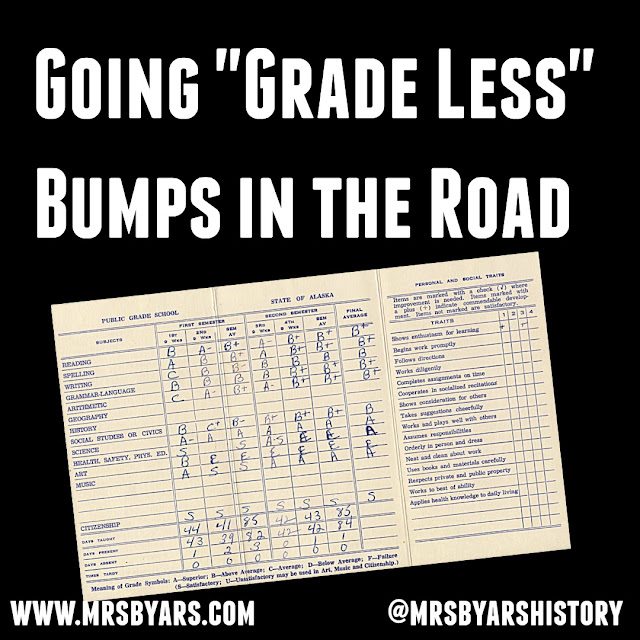
How are we over a month in the school year? When did September happen? And why does this process seem so much more challenging than it did over the summer? Last year, I became frustrated with the question "how many points do I need to pass?" and I spent a lot of time reading about grading practices. I even tried it this summer and it was so successful that I felt the need to do it this year as well. But right now, I have to be honest, I am feeling a little uneasy. Summer was so successful and now I feel like I am hitting some major roadblocks. I think I have solutions for all of them but I also feel the need to share some of the challenges I am currently facing. The first challenge is access to technology.  Over summer I was lucky to have just enough devices in the classroom, and enough students with phones, that every student could be connected at once. I don't have that this year and while I have tried to make computer labs work and I've tried to embrace ...

New Year, New Goals: The Standing Desk

Image
I am just a few days into the new school year and I am already loving some of the big changes I made this summer. I am hoping this momentum lasts because right now my classroom feels energized, positive, and creative when students are in the room. The Standing (& Rolling) Desk I am obsessed. It all came about because I wanted to make sure I was more engaged with my students during class. We teach on block schedule and I found myself sitting more than I liked during class last year. It made it so students had to come to me for help and I felt like that made the classroom focused on me as the teacher and not as focused on the students as I wanted my room to be. I want my students to never feel uncomfortable asking questions, when I am sitting behind a giant desk are they as willing to raise their hand and call me over? I noticed a few other teachers had standing desks but I just couldn't justify spending money on something I wasn't 100% sure about, what if I nee...

APSI at San Gabriel Day 1: Is Homework Required for an AP Course?

Image
Next year will be my first year teaching AP World History. The course covers all of human history and asks students to complete a test in May in which they must complete a multiple choice section and write three different types of responses, two of which are long essays, while consistently asking students to contextualize and analyze a variety of historical primary and secondary sources. To be honest, I wasn't entirely thrilled about a 4 day AP World History summer institute. I was worried it would be dry, content heavy, and would lack specific concepts and tools I could use in my class. I am incredibly happy to be proven totally wrong.  The speaker at APSI San Gabriel this year is Aaron Marsh and he has done an excellent job giving us a general view of the course while breaking up the day with activities we can use in our classroom right away that support the historical thinking skills we will need to develop in our students.  But what really struck me and wha...

Going "Grade Less": Bumps in the Road

Image
This summer I am experimenting with reflective grading practices in my World History summer school class. It felt necessary to find a new approach to grading after months of reading and research and countless moments in my classroom where traditional grading systems just weren't cutting it. I was fed up with "how many points is this worth?" or "how many points do I need on this to just pass the class?" Many students weren't trying to learn, they often weren't trying to improve or achieve an academic goal, they were playing a game of points. My first week of reflective grading still feels like a monumental success, students understand the process, students are listening to feedback and trying again on their work, and most students when asked how the process was going for them responded positively. But a few students raised some excellent concerns in the first week that I'd like to share. 1) The 4 point rubric and the traditional online gra...

Going "Grade Less": Thoughts on Reflective Grading Week 1

Image
I am one week into teaching a four-week long summer school course that I am grading using only students reflections on the learning objectives and right now my mind is racing. I started writing about why I decided to go "grade-less" last week and in five short days of summer school World History, I have a lot of thoughts and emotions to sort through. Everything is kind of messy, but the good kind, the kind that feels like progress. Here is a brief update on a few of my thoughts so far. 1) OMG I love Station Rotation Dear Catlin Tucker , Thank you. Your blogs and tweets about Station Rotation in secondary school inspired me to try it and I get it now. It is the best way to find time to meet with students, to host interventions, to differentiate instruction, and to keep students engaged by keeping class moving with a variety of activities and assignments. This model of teaching allowed me to meet with students one-on-one in a way that was effective and meaningful.  ...

Summer Experiment: Going "Grade-Less"

Image
It's Friday morning of my first week of summer and I am getting things together to take back to campus because I start summer school on Monday. I love summer school. Four short weeks of accelerated teaching, a crash course of content with students who all have a reason to be there, summer school is full of this energy and drive you don't get in the normal year. I also love summer because it is the perfect place to try something new. This summer, I am changing my grading practices. I am changing my grading practices because I am frustrated by how often students copy and cheat, I am frustrated by how defeated students become from a zero, I am frustrated by the question "how many points do I need on this assignment to...?", I am frustrated that compliance is more important than learning, I am frustrated that the traditional system offers little room for growth mindset, I am frustrated that my traditional grading practices don't focus on learning at all. So, I ...

Book Review: Rethinking Grading

Image
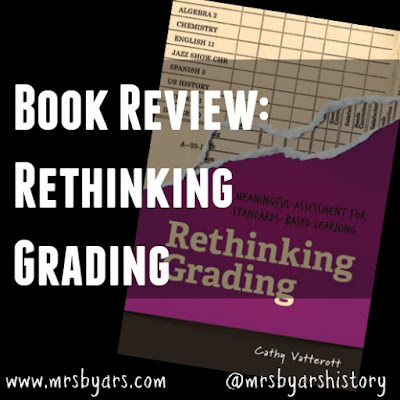
Why I Picked up the Book How do you grade? What is the purpose of grades? And what do grades actually mean? These are questions that plague me as I stare at stacks of work to grade and wonder if the grades I give truly serve me students the way I want them to. I've already read on the subject but still had more questions so I decided to focus my next reading on a book about Standards-Based Grading.  The Review Rethinking Assessment by Cathy Vatterott  clearly explains what standards based grading is, how it can help our students and change our classrooms, and how to practically implement both on the classroom level and school wide. Throughout this book, she raised the exact questions I have been facing in my classroom and made clear and solid arguments for how adopting a Standards Based Grading practice could address those issues.  The most compelling case made in this book is that we need to move away from compliance only classrooms. That by teaching comp...